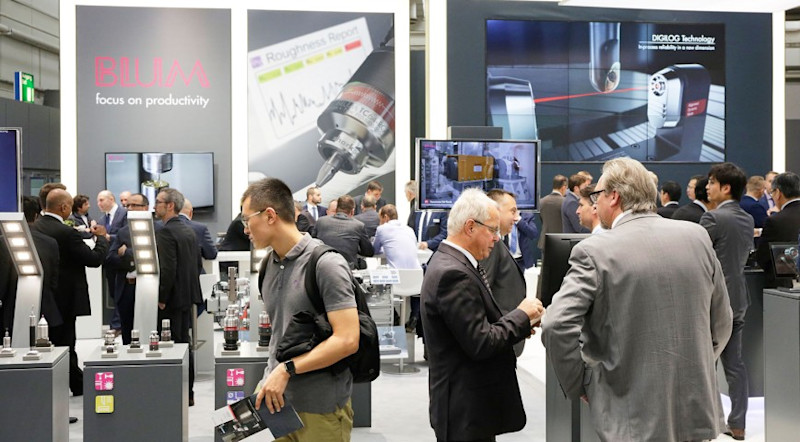
The message from the September show in Hannover, EMO 2017, is clear: The European industrial scene is one of prosperity; the Eurozone has recovered and demonstrates a healthy growth; and overall, markets of the EU are again attractive for manufacturing technology suppliers. In fact, results of a survey conducted after the show predict an optimistic €20 billion (U.S. $23.4 billion) could be invested in new technology over the next 24 months.
In 2015, visitors came to see the latest in additive manufacturing. Today, that technology is considered mainstream. Digitalization, connectivity, and Industry 4.0 were the buzzwords for this year’s show. EMO 2017 sported the slogan “Connecting Systems for Intelligent Production,” and the exhibitors were talking non-stop about digital. One chairman of a large exhibitor said, “We have come to present the market-ready product for digital manufacturing.”
EMO statistics: They’re great!
More than 2,200 companies from 44 nations, including the United States and China, exhibited.
Attendance exceeded 130,000 - more than half came from abroad.
EMO is a predominately European event - of the foreign visitors, about 70 percent were European – and at least 60,000 were domestic visitors.
The majority of Asian attendees were from China, in many cases with interest in technology for investment projects.
Quite understandably, at the EMO seminars, the United States was featured as one of the “promising markets,” in addition to India and Mexico. It was good to see strong AMT member and staff presence. As many as 70 exhibitors were associated with AMT – an all-time record.
Many have their original roots in Europe or Asia. Some, like BIG KAISER (“Higher performance – guaranteed”) and Haas Automation (“No alternative for international business but EMO”) were featured as enthusiasts in the show news. Many others simply were pleased with the visitor flow to their booths.
Potential buyers from the Russian-speaking world, as well as from Central Europe, were noticeable at the show, with their promise of business. Still, Russia, together with Turkey and the United Kingdom, were described informally as the current “problem children” of the European markets.
Exhibitors were happy to disclose the figures for actual orders they received at the show. They amount to a staggering €8 billion (U.S. $9.3 billion). Needless to say, the organizers declared the show of the “World of Metalworking” as an incomparable success.
Much of the success of the show is attributable to the fact that the European market is ripe for the technology to move faster into the digital age. Figures from EMO show that there is opportunity in Europe and definitely worthy of a look.